Public software equities lost approximately $285 billion in valuation during the first quarter of 2026 in what the financial press is calling the SaaSpocalypse. The thesis is brutal and simple. Per-seat pricing assumes a human in every seat doing per-seat-priced work. AI agents do the work of multiple humans. The seats collapse. The revenue model collapses with them.
This is not a market correction. It is a category extinction event. And the companies still pricing on seats are running on borrowed time, mostly because their pitch decks have not been updated since the prior decade.
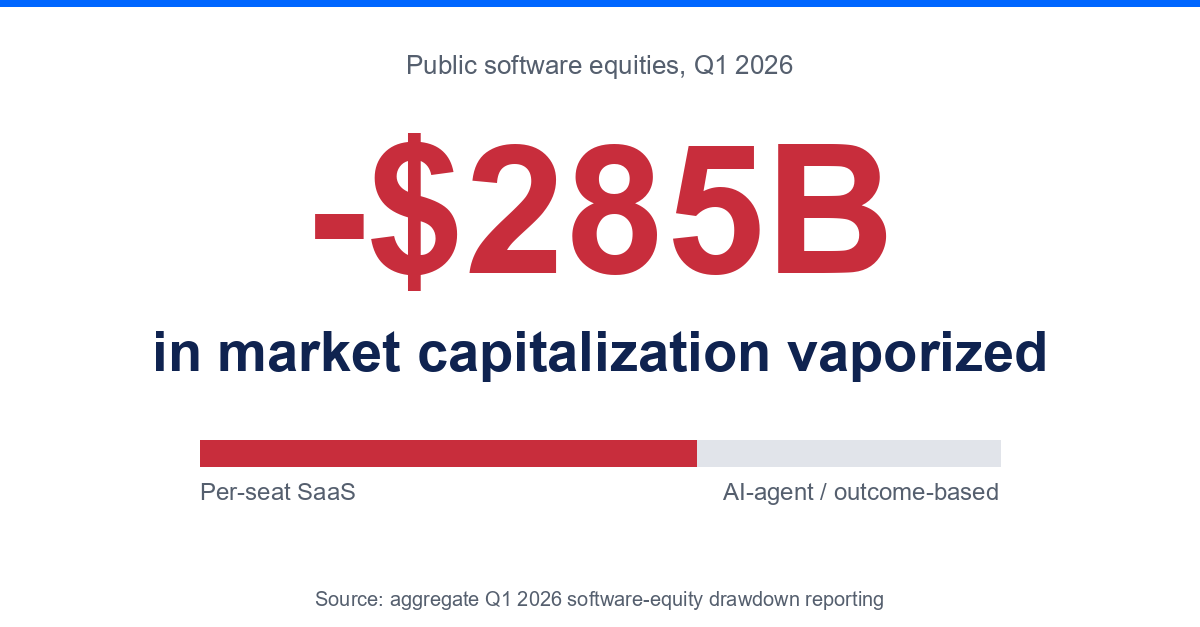
Aggregate Q1 2026 public software-equity drawdown. The market is repricing seat-based revenue to its new economic reality.
The model that built the prior decade
For twenty years, enterprise software ran on a single business model. Build a feature. Slot it behind a per-seat license. Sell to whoever has procurement authority at the customer. Charge per user per month. Compound revenue through annual contracts. Spend forty cents of every dollar on sales and marketing. Dilute heavily on the way up because growth was the only metric that mattered.
The model worked because the unit of work in the buyer's organization was a human at a desk. The human used the software to do the work. The customer paid the software vendor for the human's access to the software. As the customer's headcount grew, the software vendor's revenue grew. The math compounded.
This model produced more multibillion-dollar outcomes than any business model in the history of software. It also produced an entire profession of go-to-market specialists, an entire layer of venture capital, and an entire shorthand vocabulary of metrics. Net revenue retention. Logo retention. Per-seat ARPU. CAC payback. The vocabulary assumes the model. The model assumes the seat. The seat assumes the human.
Strip away the seat and the entire stack falls.
What stripped the seat
AI agents now perform the unit of work that used to require a human at a desk. Salesforce's Agentforce charges $2 per conversation, not per seat. Intercom's Fin charges $0.99 per resolved conversation. The customer is no longer paying for access. The customer is paying for completed work.
The unit of measurement has changed. When the unit is the conversation or the resolved ticket or the document drafted or the office action analyzed, the seat becomes invisible. One AI agent can do the work that used to require five humans in five seats. The customer's headcount stays flat or shrinks. The vendor's per-seat revenue, which was supposed to compound on customer growth, no longer does.
Gartner is forecasting that by 2030, at least forty percent of enterprise SaaS spend will shift to usage, agent, or outcome-based pricing. That number is conservative. The shift is faster than the analyst class is willing to admit publicly because the analyst class is heavily exposed to the prior model.
The financial markets have already started repricing. The $285 billion that came out of public software valuations in the first quarter is the market's first attempt at marking the seat-based revenue stream to its new economic reality. It will not be the last attempt. The seat-based companies that have not yet announced a usage-based product will see further compression as quarterly results show seat erosion.
The pricing transition is not optional
There is a tempting argument that goes like this. Yes, AI agents are doing some of the work, but the seats will hold because customers still need humans to manage the agents, validate output, and handle edge cases. Per-seat pricing will adapt by adding agent-per-seat surcharges or premium tiers, and the model survives.
This argument is wrong, and the reason it is wrong is the same reason all incumbent-defense arguments are wrong. The competitive landscape does not let you keep the prior pricing model just because you would prefer to.
Here is what actually happens. A new entrant prices on outcomes. A customer evaluates the new entrant against the seat-based incumbent. The new entrant's price is a fraction of the seat-based price for the same outcome. The customer switches. The customer tells other customers. Procurement at every customer pulls up its existing seat-based contracts and asks the obvious question. Why are we paying per seat when this competitor charges per outcome and we are getting a better number?
The seat-based incumbent then has to choose between two unattractive options. Option one, defend the seat-based model and lose customers to the new entrant. Option two, introduce a usage-based product that cannibalizes the seat-based revenue. Most public companies choose a third option, which is to do nothing visible while quietly losing customers to the new entrants and hoping the next quarter's results conceal the trend. That works for one quarter. Then the trend becomes visible, the stock takes a hit, and the next earnings call gets ugly.
This is exactly what produced the $285 billion drawdown. The market is not pricing in a future risk. The market is pricing in the trend that is already happening.
What replaces seats
The model that wins the next decade looks different from the model that defined the prior one. Five characteristics.
The unit of pricing is the unit of work, not the unit of access. The customer pays when the work happens, zero when it does not. The vendor's revenue is tied to the value the customer derives from the product, not to whether the customer remembered to log in.
The product is integrated with how the customer actually works, not with how the customer's procurement department defines work. The integration is deeper because the value capture is tied to outcomes the customer can measure. Sales motion shifts from "convince procurement we are best of breed" to "show the customer the work we just did and the price."
The cost structure is sustainable at small unit prices. The vendor that wins is the vendor whose marginal cost per unit of work is the lowest while preserving quality. This favors vendors with strong technical infrastructure, model efficiency, and operational discipline. It does not favor vendors with the largest sales teams, which is exactly the inversion the prior model created.
The customer base expands beyond the prior buyer profile. Outcome-based pricing creates economic accessibility for buyers who could never afford the per-seat model. The total addressable market grows. New entrants emerge in adjacent verticals because the cost of entry is lower. This is the second-order Jevons effect.
The metrics change. Net revenue retention assumes annual contracts and seat compounding. Outcome-based businesses report differently. Volume of work delivered. Quality of output. Per-customer outcome counts. The metrics that the public market is currently using to value software companies are about to look obsolete, and a new vocabulary will emerge to replace them.
A clean example from a small market
The patent prosecution market is too small to move equity indices but too clean to ignore as a case study. The historical price for a small-entity office action response was hours of billed attorney time. That price was set by the cost of a partner reading work an associate had spent hours producing. The associate's hourly rate, the partner's overhead, the firm's pyramid economics. All of it priced into the response.
When AI handles the mechanical layer of the response, the cost structure changes. The AI side of the same response, delivered through a usage-based tool with attorney verification, is a flat $99. The customer is the same. The work is the same. The quality, when verified, is the same. What collapses is the price of the mechanical layer.
The economic consequence in patent prosecution is exactly what the SaaSpocalypse is forecasting at scale. New filers enter who never existed at the prior price. The total volume of work expands. The vendors that win are the ones that priced for the new volume, not the ones that defended the old price. The firms that did not adjust lose mechanical-layer billables. The firms that did adjust lose hourly billing model leverage. The whole stack reprices around the new unit of work.
What survives is the judgment layer, where humans add value the AI cannot. What dies is the layer that exists to subsidize the seat-based or hour-based pricing of the prior decade.
What founders should do this quarter
Three concrete actions for software founders in any vertical, not just legal tech.
One. Read your own pricing page with the eyes of a procurement officer in 2026. If your model is per-user-per-month, write down what unit of work that user is supposed to perform. Write down whether an AI agent could do that unit of work for the customer. If the answer is yes or even soon, you are running on borrowed time and the next round will price that risk in. Start designing the usage-based equivalent now, before the stock or the round forces it.
Two. Stop counting seats as the metric of customer growth. Count the unit of work delivered. The metric you choose to measure with is the metric that determines what you build. If you are still measuring seats, you are still building seat-based features. If you start measuring outcomes, you start building outcome-aligned features. The latter is what wins the next decade.
Three. The integration depth matters more than the feature checklist. The vendors that survive will be the ones whose product does not just ride alongside how the customer works but is integrated into the customer's actual workflow. AI agents that read from verified data sources, respect deterministic boundaries, and produce auditable output are the ones that will be trusted with outcome-based pricing. AI agents that hallucinate facts under probabilistic generation will not.
The window on this is shorter than it looks. The companies that have already announced usage-based products are already capturing the disappointed seat-based customers. The companies still on per-seat will see their numbers degrade quarter over quarter until either they announce a usage-based product or they get acquired at compressed multiples by a competitor that did.
Why we built Abigail this way
Abigail is the patent prosecution platform we built specifically to operate inside the new economics, not the old.
The pricing is the unit of work. $99 per office action response. No subscription, no seats, no annual contract. $25 in free credits at signup. The customer pays when the work is delivered. The customer pays zero when the customer does not need the work that month. The pricing matches what the customer is buying.
The architecture matches the pricing. The AI is read-only. It has no create, delete, or write privileges anywhere in our system. It can read your office action and the cited references. Every conclusion the system shows you links to the source passage you can click and read. The deterministic verification layer enforces what the probabilistic generation layer is allowed to claim. This is what makes outcome-based pricing trustworthy. If the output is wrong because the AI hallucinated, the customer paid for nothing. If the output is right because the verification layer enforced the source-link requirement, the customer paid for a verifiable result.
This is the only architecture that survives the next decade of software. The pricing that matches it follows naturally.
Try Abigail on your next office action
$99 per response. $25 in free credits at signup. No subscription, no seats. Read-only AI architecture. Every conclusion linked to its source.
Get Started