The acceleration of AI driven innovation has produced a growing chorus of critics who argue the patent system is too slow, too expensive, and too rigid to serve its original purpose. Jack Dorsey tweeted "delete all IP law." Elon Musk responded "I agree." Peter Diamandis describes a world of post scarcity abundance where AI compresses decades of R&D into weeks. They are all half right. This paper argues that the patent system is not dying. It is being reborn. Using economic velocity theory, Schumpeterian creative destruction, and 25 years of patent prosecution experience, I derive a framework for understanding why AI to AI prosecution is not just inevitable but necessary, and why the human inventor remains central to the system even as AI does most of the work.
I. The Velocity Problem
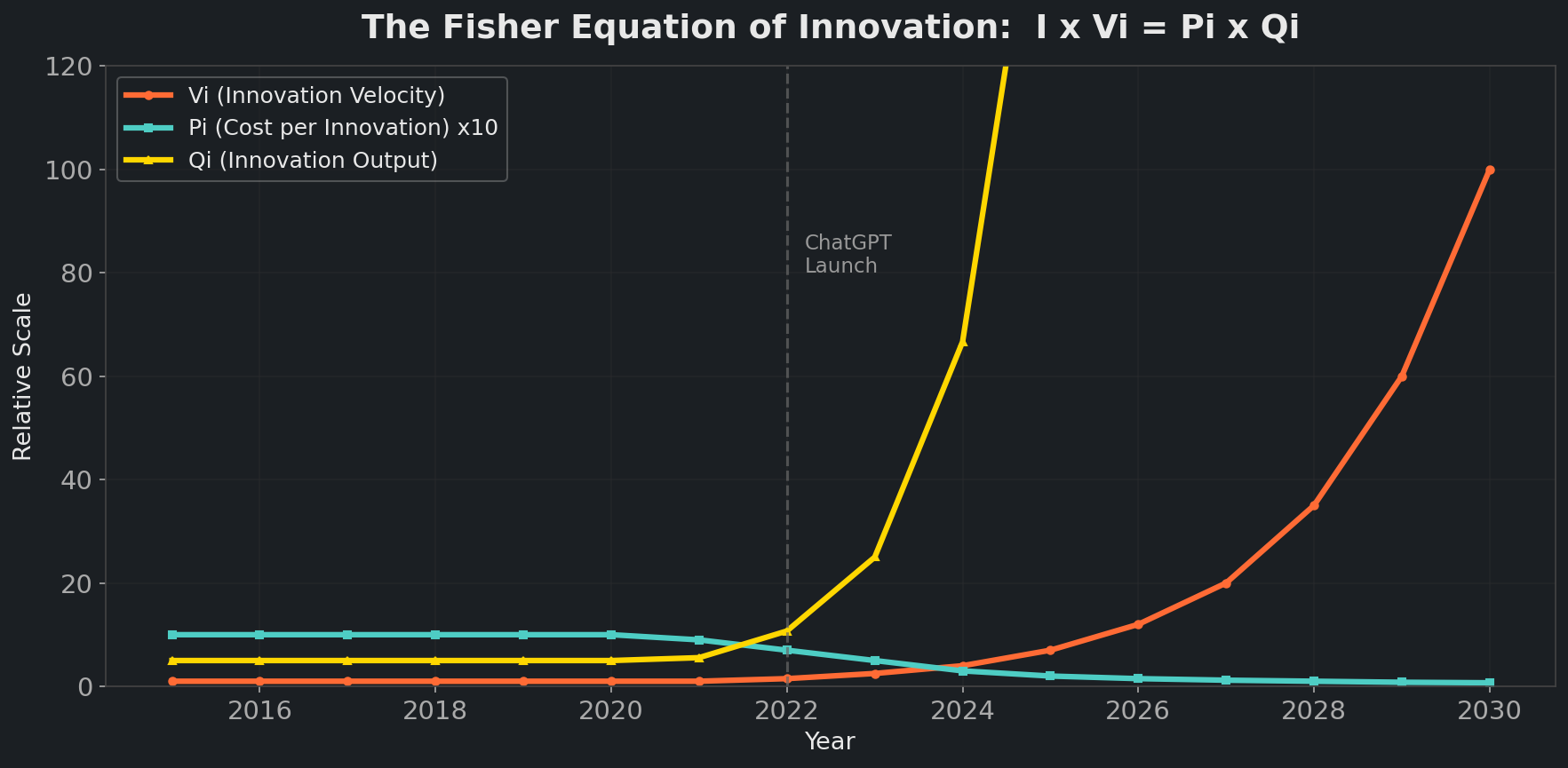
In classical economics, the velocity of money (V) describes how quickly currency circulates through an economy. Irving Fisher's equation of exchange:
Where M = money supply, V = velocity of circulation, P = price level, Q = quantity of goods.
Apply this to innovation. Define:
- I = innovation capital (ideas, talent, compute, data)
- Vi = velocity of innovation (rate at which ideas move from conception to commercial deployment)
- Pi = price of innovation (cost to develop and protect)
- Qi = quantity of commercially viable innovations
Pre AI, Vi was constrained by human cognitive bandwidth. A pharmaceutical company might spend 12 years and $2.6 billion developing a single drug (the Tufts CSDD estimate). A patent attorney might spend 40 hours drafting a single application. The USPTO examiner spends an average of about 19 hours reviewing it (per GAO reporting). The system was designed for this speed.
Now consider what happens when Vi increases by orders of magnitude. GPT class models can generate novel chemical compounds in seconds. AlphaFold predicted the structure of 200 million proteins. AI driven drug discovery companies like Insilico Medicine moved from target identification to Phase I clinical trials in under 30 months.
The patent system's average first action pendency is now 22 to 26 months (USPTO FY2025). Total pendency from filing to grant averages 24 to 36 months. The backlog stands at over 1.19 million pending applications with 813,000 unexamined.
II. The Schumpeterian Paradox
Joseph Schumpeter argued in Capitalism, Socialism and Democracy (1942) that capitalism's engine is creative destruction: the continuous replacement of old technologies by new ones. He noted that innovations come in "swarms" because they facilitate one another (what modern economists call spillover effects).
Schumpeter was notably ambivalent about patents. He saw them as one of many mechanisms firms use to temporarily capture monopoly rents from innovation. The patent is not the incentive to innovate. The prospect of temporary monopoly profit is the incentive. Patents are merely one instrument.
If AI compresses the innovation cycle from years to weeks, then the traditional 20 year patent term becomes absurdly long relative to the commercial lifecycle of the invention. A patent filed today for an AI architecture will be technologically obsolete before it issues.
But here is where the critics get it wrong. Not all innovations are equal. Schumpeter's swarms contain both incremental improvements (which AI excels at producing) and foundational breakthroughs (which still require human insight, domain expertise, and cross pollination from lived experience).
This is precisely the kind of non analogous art combination that patent law was designed to protect. Section 103 of Title 35 asks whether an invention would have been obvious to "a person having ordinary skill in the art." The doctrine of non analogous art provides that references from unrelated fields cannot be combined to reject a claim unless the inventor would have had reason to look there.
III. The 3% Problem and Why AI Changes the Math
A widely cited statistic holds that the ratio of U.S. patent value to R&D spending for firms is approximately 3% (Hall, Jaffe & Trajtenberg, Research Policy). This number is often misinterpreted to mean that only 3% of patents have commercial value.
The actual finding is more nuanced. Patent value follows an extreme power law distribution. A tiny fraction of patents are extraordinarily valuable. Most are worth very little.
AI changes this distribution in two ways.
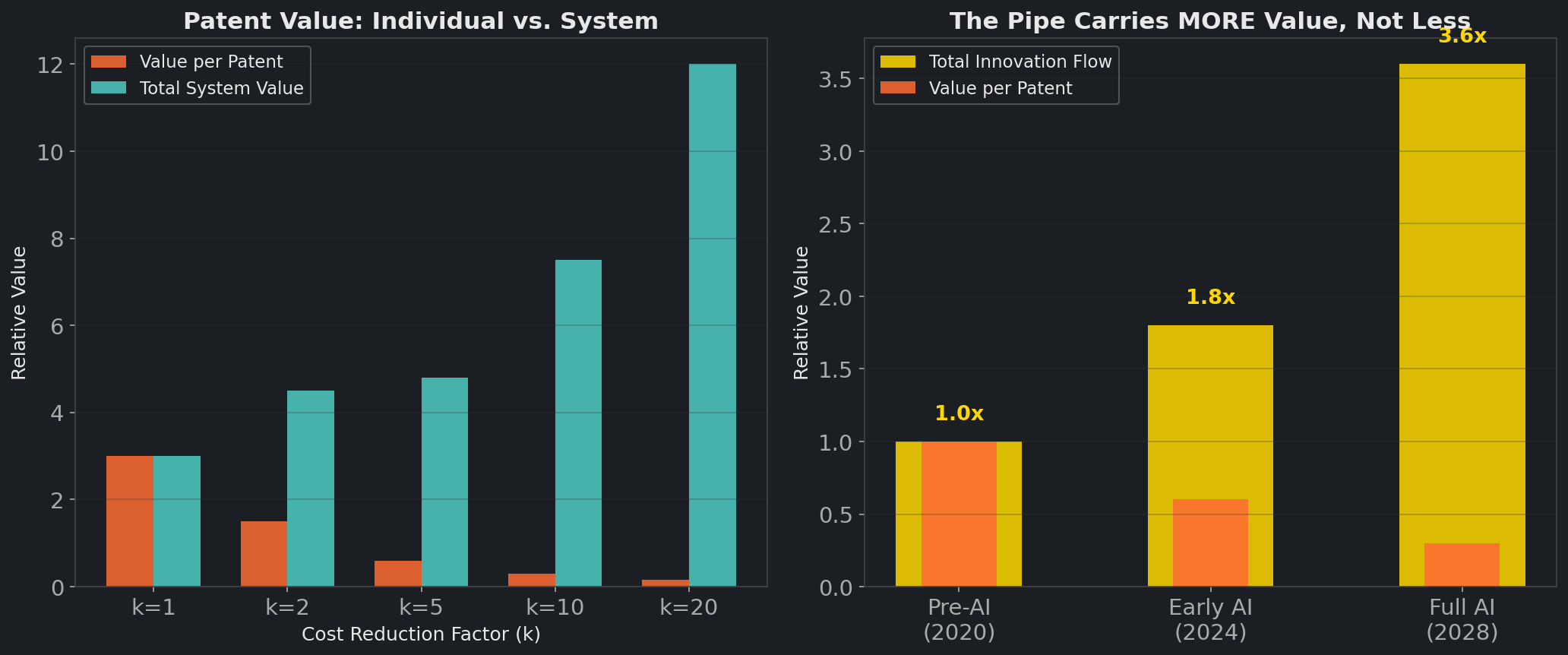
First, AI dramatically reduces the cost of R&D. If AI cuts the cost of generating and testing hypotheses by 90%, then the same 3% ratio applied to a much smaller denominator yields a much higher absolute value per dollar spent.
Second, AI increases the hit rate. Machine learning can predict which compounds are likely to succeed, which patent claims are likely to be allowed, and which markets are likely to adopt a technology.
If R&D cost drops by factor k and hit rate increases by factor h, then:
For k = 10 (90% cost reduction) and h = 3 (3x hit rate improvement):
IV. The Disclosure Function in an Age of Design Around
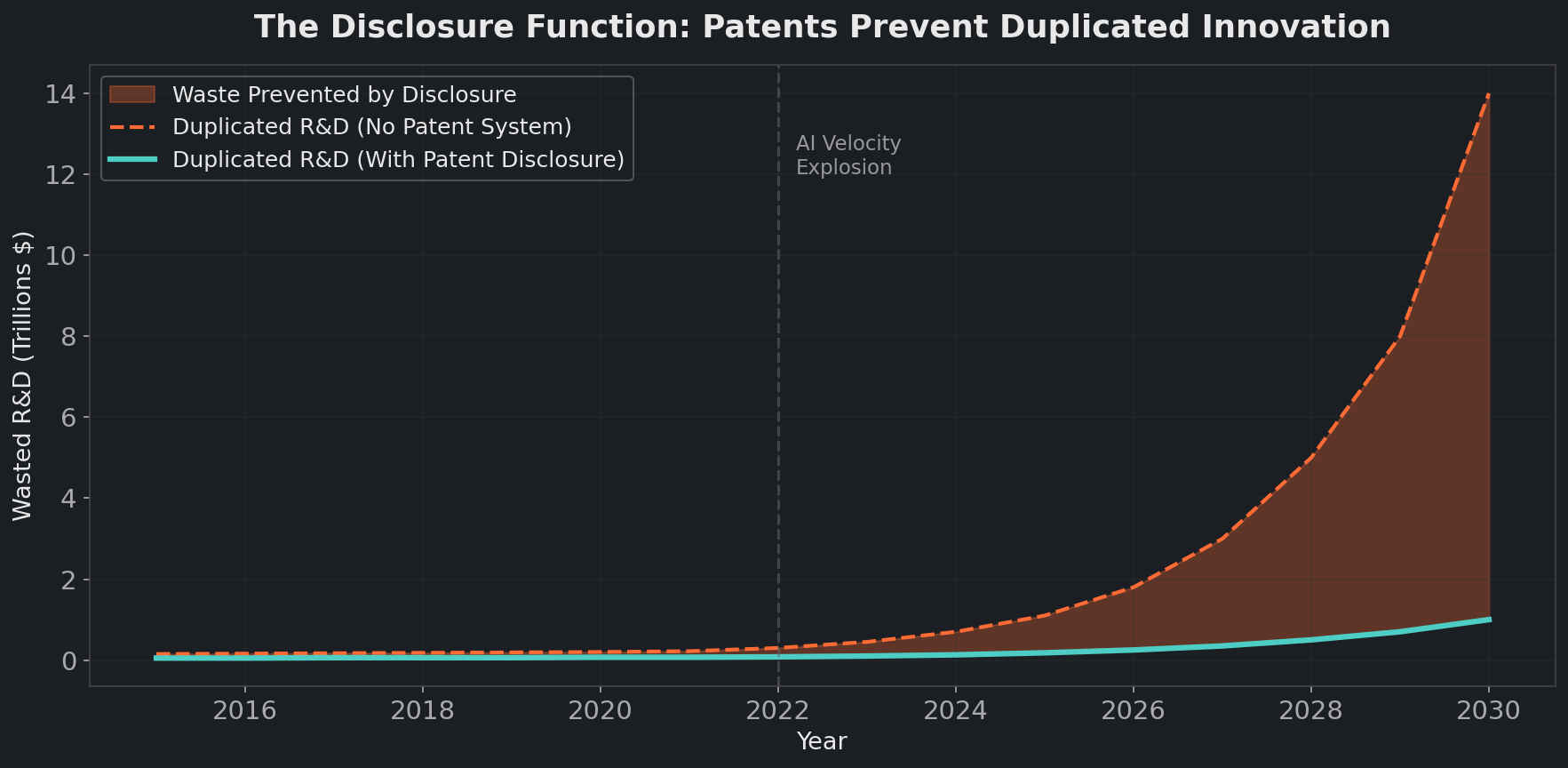
Patents serve two functions: exclusion and disclosure. The exclusion function gets all the attention. You file a patent so competitors cannot copy your invention for 20 years.
The disclosure function is arguably more important. The patent bargain requires the inventor to disclose the invention in sufficient detail that "one of ordinary skill in the art" can reproduce it. In exchange, you get the temporary monopoly.
In the age of AI, design around becomes trivial for most inventions. An AI system can read a patent, understand the claims, and generate alternative implementations in seconds. The 20 year exclusion window is functionally irrelevant for most software and AI inventions because the technology will be obsolete in 2 to 3 years.
V. Enablement, Written Description, and the AI of Ordinary Skill
Section 112 of Title 35 requires that a patent specification be written such that "one of ordinary skill in the art" can make and use the invention. This standard has always been calibrated to human capability.
But what happens when the person of ordinary skill has access to AI? A claim that was not enabled in 2020 because no human could synthesize the described compound without extensive experimentation might be fully enabled in 2026 because an AI system can follow the specification and produce the compound in hours.
VI. Inventorship Is Murky. AI Makes It Murkier. That Is Fine.
The U.S. Supreme Court denied certiorari in Thaler v. Perlmutter on March 2, 2026, affirming that only natural persons can be named as inventors. The DABUS AI system cannot be an inventor. This is the correct legal outcome.
In practice, inventorship determination has always been murky. Courts have called it one of the most difficult issues in patent law. In my 25 years of practice, I have watched firms routinely list all team members as co inventors to avoid the costly exercise of determining who actually conceived of what.
The real question is: when a human interacts with AI and a light bulb goes off, who conceived of the invention?
VII. The Case for AI to AI Prosecution
If invention is accelerating, prosecution must accelerate proportionally. The current system cannot process 1.19 million pending applications with roughly 813,000 unexamined (USPTO patent inventory data) using human examiners working about 19 hours per application.
Phase 1: AI Assisted Human Prosecution (Current)
AI drafts applications. Humans review. AI analyzes Office Actions. Humans strategize. AI suggests arguments. Humans evaluate. This is where ABIGAIL operates today.
Phase 2: AI to AI Prosecution with Human Oversight (2027 to 2030)
AI systems prepare and file applications in structured formats (JSON schema rather than prose). USPTO AI examiners conduct prior art search and analysis. AI prosecution agents respond to rejections with human attorney approval at key decision points. Pendency drops from 24 months to 24 days.
Phase 3: AI to AI Prosecution with Human Exception Handling (2030+)
Routine applications are filed, examined, and allowed entirely by AI systems. Human attorneys handle appeals, inter partes proceedings, and strategic portfolio decisions. The patent office becomes a real time registration and examination system.
VIII. A Mathematical Framework for Innovation Velocity and Patent Value
Define the innovation production function:
Where:
- Qi(t) = innovation output at time t
- A(t) = total factor productivity (state of knowledge)
- I(t) = innovation capital
- H(t) = human cognitive input
- AI(t) = AI augmentation factor
- α, β, γ = output elasticities
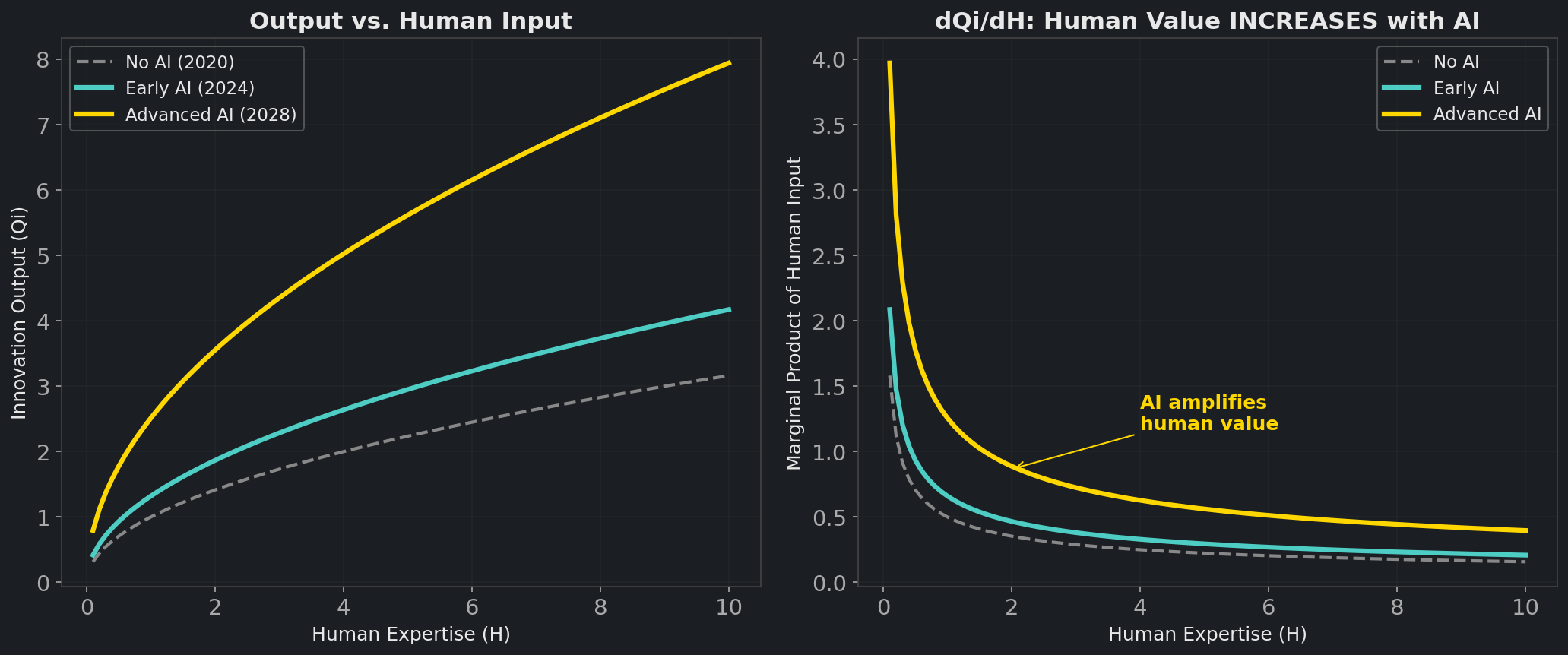
Pre AI: γ = 0, Qi depends only on capital and human input. Post AI: γ > 0 and growing, AI(t) grows exponentially.
The key insight: as AI(t) grows, the marginal product of H(t) does not go to zero:
For patents specifically, define the patent value function:
AI increases novelty, non_obviousness, utility, and may increase market_size. Therefore:
Patent value increases with AI capability, not decreases. The critics are looking at the wrong variable.
IX. Conclusion: Patents Are Cooked. Long Live Patents.
Jack Dorsey is right that the IP system as currently structured cannot keep pace with AI driven innovation. Elon Musk is right that patents should not be used as weapons by trolls. Peter Diamandis is right that we are entering an era of abundance where AI compresses decades of R&D into weeks.
But they are all wrong to conclude that patents are therefore irrelevant.
The patent system needs to be rebuilt, not deleted. AI to AI prosecution is the path forward. The disclosure function becomes more valuable as AI consumes that disclosure as training data. Human inventorship remains central because AI amplifies human insight rather than replacing it. The 3% value ratio shifts upward as R&D costs fall and hit rates rise.
Patents are cooked in their current form. In their next form, they are more important than ever.
References
- Fisher, I. (1911). The Purchasing Power of Money. Macmillan.
- Schumpeter, J. (1942). Capitalism, Socialism and Democracy. Harper & Brothers.
- Hall, B.H., Jaffe, A., & Trajtenberg, M. (2005). "Market Value and Patent Citations." RAND Journal of Economics.
- Hall, B.H. (2007). "The Value of U.S. Patents by Owner and Patent Characteristics." Research Policy.
- Magesh, V. et al. (2024). "Hallucination Free? Assessing the Reliability of Leading AI Legal Research Tools." Stanford RegLab.
- Dorsey, J. (2025, April 17). "delete all IP law" [Tweet]. Twitter/X.
- Musk, E. (2025, April 17). "I agree" [Reply]. Twitter/X.
- USPTO (2025). Patents Dashboard: Pendency Statistics.
- Thaler v. Perlmutter, No. 23-15823 (U.S. Supreme Court, cert. denied March 2, 2026).
- Holland & Knight (2026). "The Final Word? Supreme Court Refuses to Hear Case on AI Authorship."
- Diamandis, P. & Wissner-Gross, A. (2025). "How We Get to Abundance by 2035." Abundance360.
- USPTO (2025). Updated Guidance on AI and Inventorship. November 2025.
- NBER Working Paper 18824. "What Do We Learn from Schumpeterian Growth Theory?"
- Thompson Patent Law (2026). "US Patent Process in 2026: Timelines, Rejections, Strategies."
Roger C. Hahn is a USPTO Registered Patent Attorney (Reg. No. 46,376) with 25 years of patent prosecution experience. He is the founder of ABIGAIL AI (abigail.app), the first AI native patent prosecution platform, and Managing Partner of Hahn & Associates PLLC. He holds a JD from Chicago Kent College of Law, an MBA from Columbia Business School, an MS in Biomedical Engineering from Johns Hopkins University, and an AI Certificate from Columbia University School of Engineering.