This is the largest single transfer of competitive opportunity from large firms to solo practitioners since the personal computer landed on attorney desks in the early 1990s. It is happening this quarter. Most solos have not adjusted yet. That is the opportunity.
The mechanical layer was the moat
For two decades, the largest firms competed on a single capability that nobody admitted out loud. They could throw a pyramid of associates at any matter, bill those associates out at premium hourly rates, and let partners read the output. The associates did the mechanical work. The partners exercised the judgment. The client paid for both.
This was a magnificent business. It was not a magnificent business because the work was magnificent. The mechanical layer was repetitive, formulaic, and brutally deterministic. Form filling. Prior art searches at the basics tier. Deposition summarization. First-draft information disclosure statements. Contract redlines on standard clauses. Document review for the obvious. The associates hated it. The partners hated reading it. The clients paid for it because there was no alternative.
The moat was access to the pyramid. A solo did not have a pyramid. A small firm did not have a pyramid. So when the matter required volume mechanical work, the matter went to a large firm. Pricing power followed.
That moat just got drained.
The mechanical layer is now free
A reasonably configured AI tool, used with appropriate verification, completes most of the mechanical layer in minutes. The work that used to take a first-year associate six hours now takes thirty minutes of AI output plus two hours of attorney review. The total compresses by roughly seventy percent. The judgment layer remains human.
This is not speculation. It is documented in the practice of every prosecutor I know who has adopted these tools seriously. It is also documented in the staffing decisions of the largest firms. One Top-10 firm laid off hundreds of support staff in the first quarter of this year, citing AI capability and a more efficient operating model. That language is not euphemism. The mechanical layer that used to require human bodies in seats does not require those bodies anymore.
What the layoffs did not say out loud is the second-order consequence. If the mechanical layer no longer requires associates, the billing structure that was built on top of associates also no longer requires those rates. The partners can do the work directly with AI assistance. So can a solo. So can a small firm. Whoever has the lowest fixed cost wins on price.
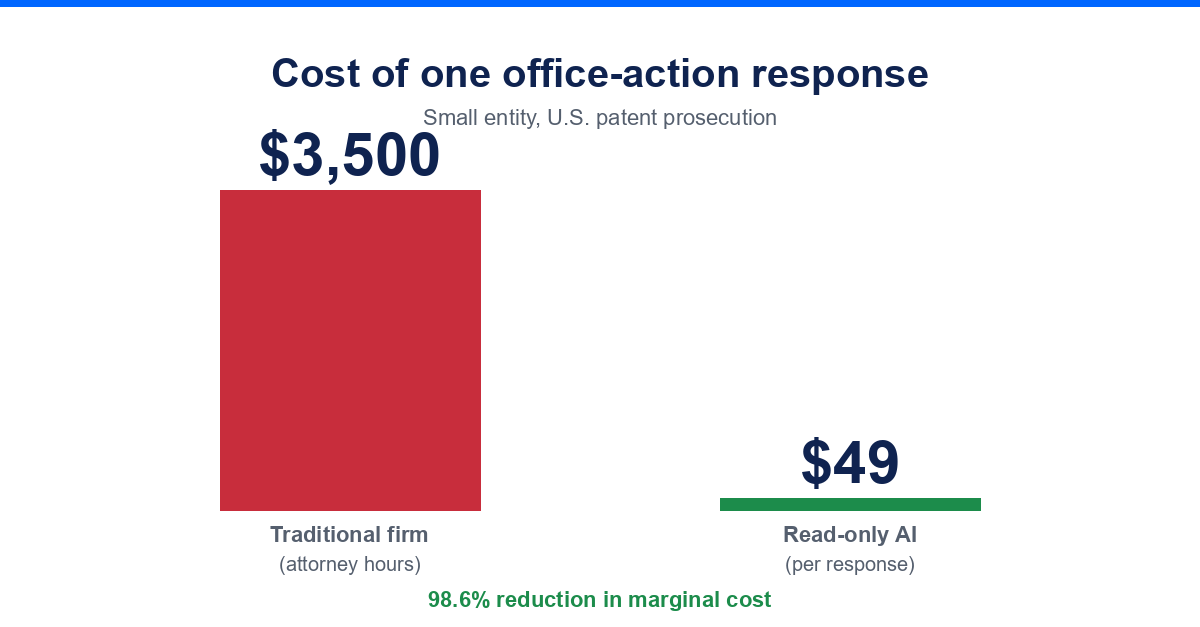
Historical attorney cost vs current usage-based AI cost. Same response, same client, same quality when verified.
The Jevons consequence
Here is where most people stop the analysis. They look at the layoffs and conclude that AI is contracting the legal market. They are reading exactly the wrong half of the equation.
In 1865, William Stanley Jevons noticed that James Watt's improved steam engine, which made coal more efficient, did not reduce coal consumption. It made coal so useful that demand exploded. Cheaper marginal cost expanded the market beyond anything the prior economy had imagined.
The same pattern is now visible in patent prosecution. Historically, a small-entity office action response was billed as hours of attorney time. New cost when AI handles the mechanical layer: $99 per response plus the attorney review. The break-even math for filing a patent moves dramatically. Inventions that previously did not justify prosecution costs now do. New filers who never existed at the prior price are entering the system. The total volume of work to be done expands. The marginal cost per unit of work falls.
So the market is not contracting. The market is repricing. The customers who could not afford the old rate are entering. The customers who could afford the old rate are no longer willing to pay it for mechanical work. The premium attaches to the judgment layer, not to the mechanical layer that used to subsidize it.
Why solos win this fight
The solo or small firm practitioner has a structural advantage in the new economics that they did not have in the old economics. Three reasons.
First, fixed costs. A solo does not pay for a Class A office in midtown Manhattan. A solo does not pay for a marketing team, a knowledge management department, a general counsel, a chief diversity officer, or any of the other operational layers that the largest firms have to support. The solo's fixed cost is rent on a small office, malpractice insurance, software, and food. When pricing power on the mechanical layer collapses, the firm that wins is the firm whose break-even point on a single matter is lowest. That is the solo.
Second, judgment in concentration. A solo who has prosecuted ten years of patents has accumulated more judgment per dollar of overhead than a partner at a top firm whose time is split across business development, supervising associates, training programs, committee work, billing reviews, and one matter every three weeks. The solo's clock is fully on the substantive work. The partner's is not. When the mechanical layer no longer subsidizes that overhead, the partner has to compete on the judgment layer, where the solo has a structural advantage in concentration.
Third, the alignment of pricing with outcomes. A solo can charge a flat fee for an office action response. The fee structure is transparent. The client knows what they are paying. The solo's incentive is to deliver the result efficiently. The largest firms cannot easily move to flat fees because the entire associate billing structure was built on hourly rates that subsidize the mechanical layer. Moving to flat fees compresses partner draws and triggers compensation negotiations the firms do not want to have.
So the solo can offer transparent flat fees. The large firm cannot. In an environment where clients are sensitive to cost and the mechanical layer is no longer a moat, that pricing transparency wins.
The honest implication
The honest implication for solo and small firm practitioners is this. You are now competing on the only axis that matters, which is the quality of judgment you bring to client work. You do not have to compete with a pyramid you cannot afford. You do not have to subsidize a billing structure built for the prior decade. You do not have to hand off mechanical work to underutilized associates.
You also do not get to coast on what worked before. The clients who used to pay full attorney rates for the mechanical layer of an office action response are not coming back to that price. The competitive frontier has moved. If you are still pricing your work as if the mechanical layer is what you sell, you are still inside the prior model. The clients who notice the new pricing first will leave.
The transition is not optional. It is happening on a quarterly basis whether the profession wants it or not.
What survives the transition
Three categories of practice survive.
Strategy and judgment work. Claim drafting strategy. Examiner interview tactics. Settlement valuation. Regulatory pathway design. Cross-border IP coordination. Anything that requires reading the room, understanding the client's business context, and making calls under uncertainty. None of this transfers cleanly to a probabilistic model.
Verification and accountability. Every output that touches a court filing, a USPTO submission, or a contract has to be verified. The attorney signs the filing. The attorney's name is on the malpractice carrier. The verification function does not delegate. It is the highest-margin layer of the practice in the new economics.
Client relationship and judgment communication. The clients want to talk to a human who understands their business and can explain a risk in plain language. They do not want to talk to an associate who is reading the work product five minutes before the call. The solo's natural advantage is being the human in the relationship.
These three layers compound with experience. They do not transfer to a model. They are the layers a solo can charge for, and the layers the largest firms cannot easily compete on without restructuring their compensation model.
What to do about it this quarter
If you are a solo or small firm patent attorney reading this, three concrete actions.
One. Stop pricing mechanical work like the prior decade. Calculate your true cost to deliver an office action response with AI assistance. Your number is going to be lower than you expect. Price the work at a level that beats the largest firms while still leaving comfortable margin for your time. The clients will notice.
Two. Pick an AI tool that respects the divide between probabilistic generation and deterministic verification. Tools that produce content from probability distributions without verifying against primary sources are how attorneys are ending up in the sanctions docket. The tools that survive will be read-only against verified data.
Three. Communicate the new pricing structure to clients explicitly. Do not let them figure it out from competitors first. The solos who articulate the value transparently will win the work. The solos who quietly maintain the old rate structure will lose it.
The window on this is narrower than it looks. The largest firms will adapt eventually. They will figure out how to bring the mechanical layer in-house with AI, restructure compensation, and compete on price. They are not adapting in this quarter. The solos who move now lock in client relationships before the incumbents catch up.
Why we built Abigail this way
Abigail is the patent prosecution AI we built to make the math above work for solo and small firm practitioners. The architecture matches the economics.
Pricing matches the unit of work. $99 per office action response, no subscription, no seats, $25 in free credits at signup. You pay for the response when you produce it. You pay zero when you do not. The pricing is what makes a flat-fee transparent practice possible.
The AI is read-only. Our models do not have create, delete, or write privileges anywhere in our system. They cannot write to the file wrapper, modify a docket entry, or persist a fact that has not been verified against a primary source. They can read your office action PDF, the cited references, and the prosecution history. Every conclusion the system shows you links to the source passage you can click and read. If we cannot point to the source, we do not show the conclusion.
This is the architecture that survives the sanctions wave. It is also the architecture that makes the new economics work for the solo. The mechanical layer compresses. The judgment layer stays with the attorney. The verification layer is enforced by the system, not by trust.
The largest firms will eventually offer something similar. They will charge more for it. The solos who adopt now will have a multi-quarter head start.
Try Abigail on your next office action
$99 per response. $25 in free credits at signup. No subscription, no seats. Read-only AI architecture. Every conclusion linked to its source.
Get Started